Wim Delvoye - Study #111 for Cloaca
 Belgian
 Auction details
| Start time | 11-5-2026 at 16:51 |
| End time | 24-5-2026 at 19:37 |
Starting bid €8,500
Buyer's premium : 15%
Missed the auction? The item may still be available. You can make one single bid in the aftersale.
| Pick up | Yes, possible |
| Location | Roeselare, Belgium |
- Description
- Wim Delvoye (1965)
| Type of artwork | Drawing / Aquarelle |
| Year | 2002 |
| Technique | Aquarelle |
| Support | Paper |
| Style | Modern |
| Subject | Abstract |
| Framed | Framed |
| Dimensions | 75 x 55 cm (h x w) |
| Incl. frame | 95 x 75 cm (h x w) |
| Signed | Hand signed |
Translated with Google Translate. Original text show .
Wim Delvoye – Study 111 for Cloaca (2000-2002)
The artist Wim Delvoye (Wervik, 1965) is one of the most idiosyncratic and provocative Belgian conceptual artists of his generation. He lives and works in Ghent and is known worldwide for his sharp, often absurd, and technically brilliant works that take aim at the human body, consumption, waste, and the art market. Delvoye mixes high technology with banal bodily functions, irony with precision, and art with science. His oeuvre includes pigmented pigs, Gothic church windows made of X-rays, and, above all, his iconic Cloaca series: monumental machines that mimic the entire human digestive process, from food intake to actual defecation. That excrement is dried, cast in resin, and sold as art—a perfect metaphor for the commercialization of the body and the art world itself.
The work:
Study 111 for Cloaca. This is one of the absolute highlights of the extensive series of preparatory studies for the Cloaca machines (2000-2002).
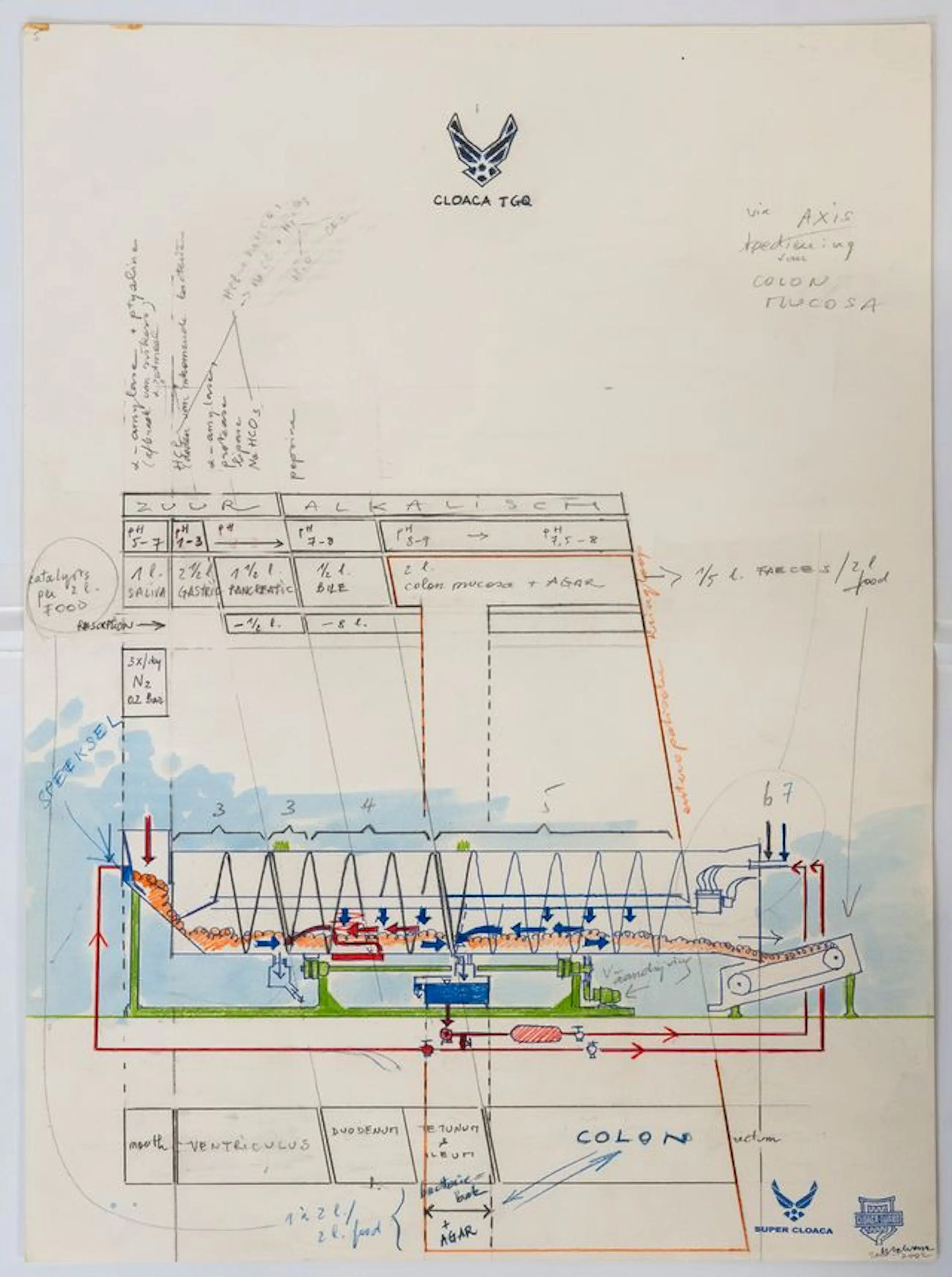
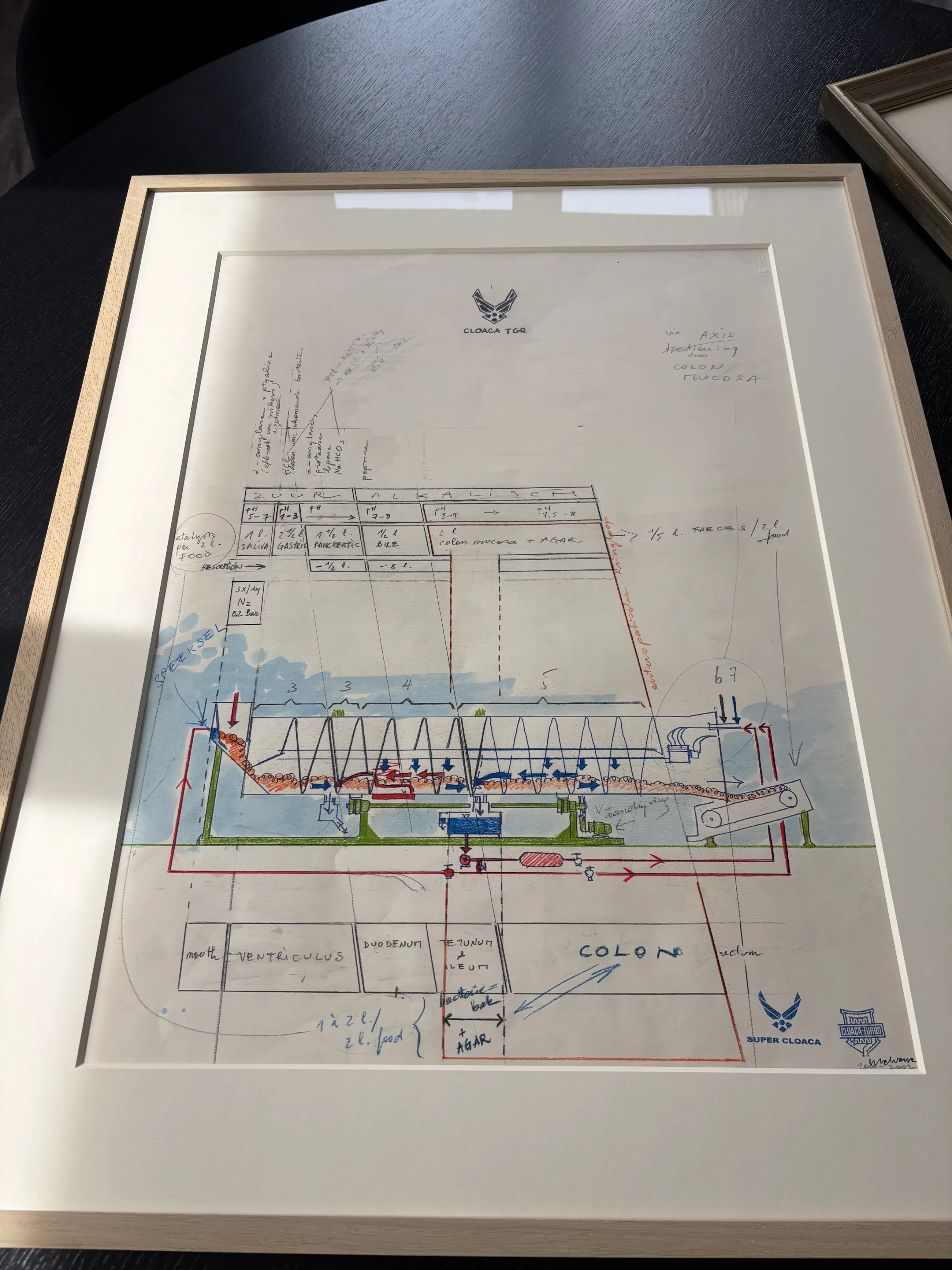
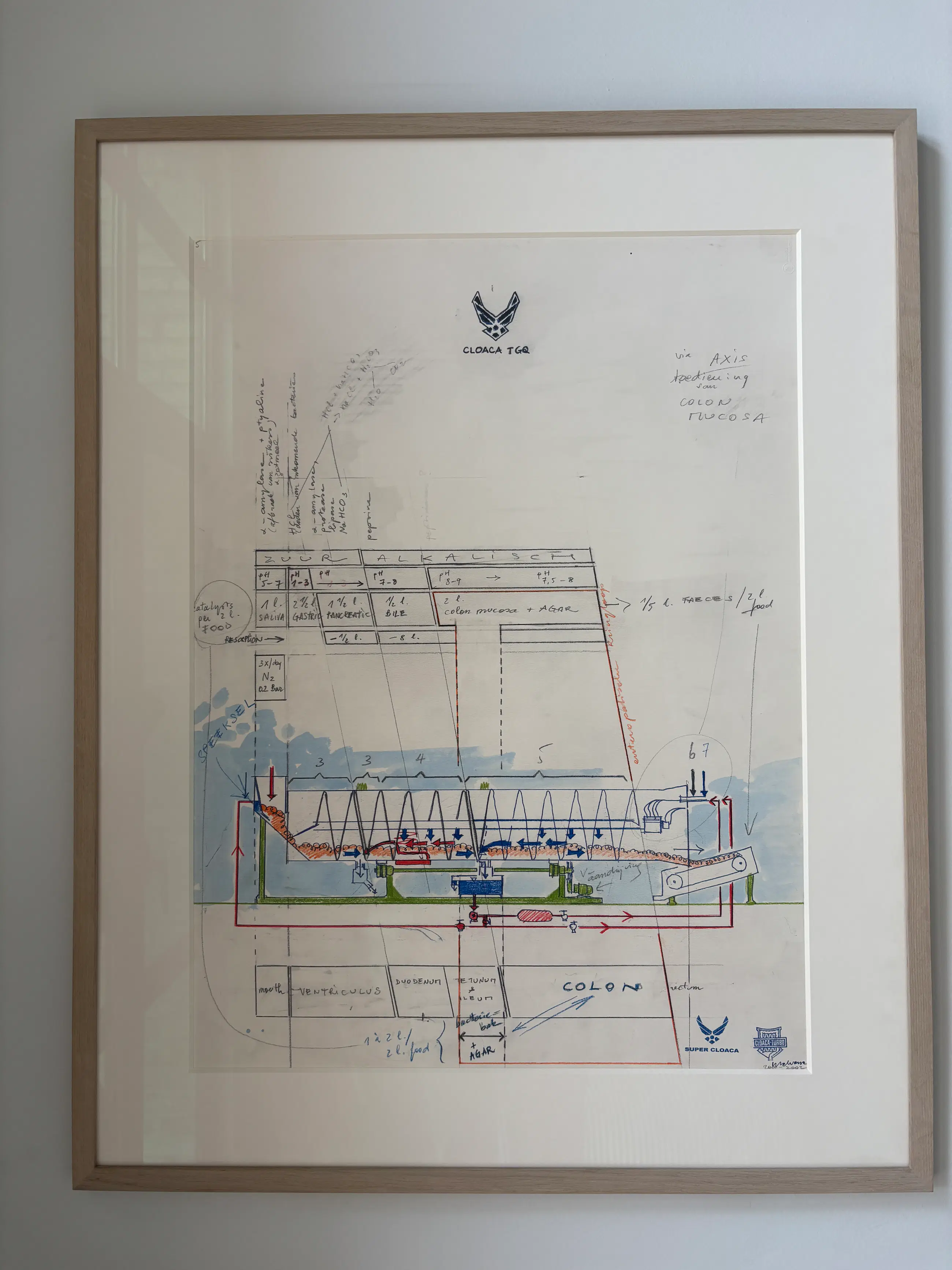
It is a mixed-media drawing on paper (55 × 75 cm, framed 75 × 95 cm), richly hand-colored with vibrant shades of blue, red, green, and orange. Delvoye has personally signed and dated the work. What you see in the attachments is a full side view of the Cloaca machine, rendered as a hyper-detailed technical design. It looks like an industrial blueprint or a military schematic, but in an aesthetically stunning, almost jewel-like execution. Every tube, every reservoir, every pump, and every valve is meticulously drawn. Striking details that immediately catch the eye: Precise annotations in Delvoye's own handwriting: volumes and compositions of digestive juices (1 L saliva, 2.5 L gastric juice, 1.5 L pancreatic juice, 1.5 L bile, 2 L colon mucosa + agar), pH values, enzymes, peristaltic movements, and the final output (“1/5 L feces from 1.5 L food”).
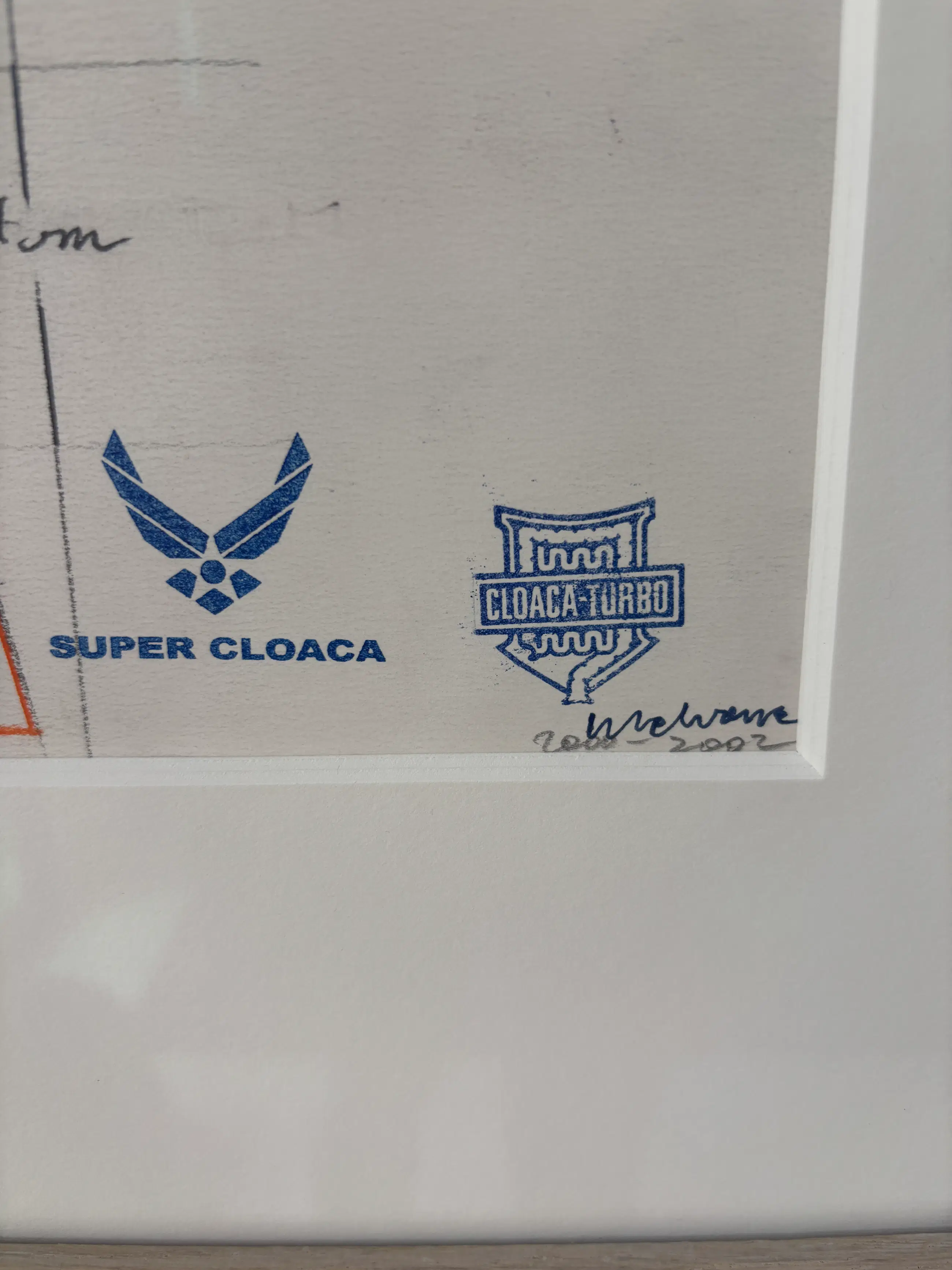
Authentic stamps applied by Delvoye himself: “SUPER CLOACA” with the iconic blue-and-white logo, “CLOACA-TURBO” in a powerful shield-shaped emblem, and at the top, the parodic “CLOACA TGQ” logo, a nod to an air force insignia. The machine is presented as a high-tech factory: sterile, efficient, and simultaneously grotesque. The colors make it visually appealing and almost graceful, while the contents remain pure scatology. Conceptual power Study 111 is not just a sketch; it is a full-fledged work of art that summarizes the essence of the entire Cloaca project. Delvoye presents digestion as a perfected industrial process; a satire on our consumer society in which everything (including our bodies) is reduced to a product. By equipping the machine with corporate logos and military branding, he exposes the irony: we feed on luxury, but ultimately produce only shit that is then traded as art.
At the same time, the drawing is so beautiful and technically perfect that it is a museum piece in itself as an object. Many connoisseurs consider this to be precisely one of the most beautiful and successful studies in the entire series.
In short: Study 111 for Cloaca is a masterful combination of technical virtuosity, visual beauty, and razor-sharp conceptual depth. A work that makes you laugh, feel disgusted, and think at the same time—exactly what Delvoye is known for. Highly recommended for anyone who gets to view the attachments in person: you don't just see a drawing, you see the brain of one of the smartest artists of his time.
The artist Wim Delvoye (Wervik, 1965) is one of the most idiosyncratic and provocative Belgian conceptual artists of his generation. He lives and works in Ghent and is known worldwide for his sharp, often absurd, and technically brilliant works that take aim at the human body, consumption, waste, and the art market. Delvoye mixes high technology with banal bodily functions, irony with precision, and art with science. His oeuvre includes pigmented pigs, Gothic church windows made of X-rays, and, above all, his iconic Cloaca series: monumental machines that mimic the entire human digestive process, from food intake to actual defecation. That excrement is dried, cast in resin, and sold as art—a perfect metaphor for the commercialization of the body and the art world itself.
The work:
Study 111 for Cloaca. This is one of the absolute highlights of the extensive series of preparatory studies for the Cloaca machines (2000-2002).
It is a mixed-media drawing on paper (55 × 75 cm, framed 75 × 95 cm), richly hand-colored with vibrant shades of blue, red, green, and orange. Delvoye has personally signed and dated the work. What you see in the attachments is a full side view of the Cloaca machine, rendered as a hyper-detailed technical design. It looks like an industrial blueprint or a military schematic, but in an aesthetically stunning, almost jewel-like execution. Every tube, every reservoir, every pump, and every valve is meticulously drawn. Striking details that immediately catch the eye: Precise annotations in Delvoye's own handwriting: volumes and compositions of digestive juices (1 L saliva, 2.5 L gastric juice, 1.5 L pancreatic juice, 1.5 L bile, 2 L colon mucosa + agar), pH values, enzymes, peristaltic movements, and the final output (“1/5 L feces from 1.5 L food”).
Authentic stamps applied by Delvoye himself: “SUPER CLOACA” with the iconic blue-and-white logo, “CLOACA-TURBO” in a powerful shield-shaped emblem, and at the top, the parodic “CLOACA TGQ” logo, a nod to an air force insignia. The machine is presented as a high-tech factory: sterile, efficient, and simultaneously grotesque. The colors make it visually appealing and almost graceful, while the contents remain pure scatology. Conceptual power Study 111 is not just a sketch; it is a full-fledged work of art that summarizes the essence of the entire Cloaca project. Delvoye presents digestion as a perfected industrial process; a satire on our consumer society in which everything (including our bodies) is reduced to a product. By equipping the machine with corporate logos and military branding, he exposes the irony: we feed on luxury, but ultimately produce only shit that is then traded as art.
At the same time, the drawing is so beautiful and technically perfect that it is a museum piece in itself as an object. Many connoisseurs consider this to be precisely one of the most beautiful and successful studies in the entire series.
In short: Study 111 for Cloaca is a masterful combination of technical virtuosity, visual beauty, and razor-sharp conceptual depth. A work that makes you laugh, feel disgusted, and think at the same time—exactly what Delvoye is known for. Highly recommended for anyone who gets to view the attachments in person: you don't just see a drawing, you see the brain of one of the smartest artists of his time.
| Condition | |
| Condition | Very good |
| First owner (bought in a gallery) | |
| Shipment | |
| Pick up | The work can be picked up on location. As a buyer you must bring your own packaging materials. The location is: Roeselare, Belgium |
| courier-service | If you are unable to collect a work yourself, you can engage a courier service to have the work collected. Click here for more information about how this works and view the rates. |
| Shipment | Due to its size or fragility, it is not possible to send this item via regular mail |
| Guarantee | |
| Guarantee | By putting the item up for auction, I agree with the Terms of Guarantee as they are applicable at Kunstveiling regarding the accuracy of the description of the item |
| Consumer law | This seller has indicated that they are a private seller. Therefore, consumer law does not apply. Read more |
The seller takes full responsibility for this item. Kunstveiling only provides the platform to facilitate this transaction, which has to be settled directly with the seller. More information .