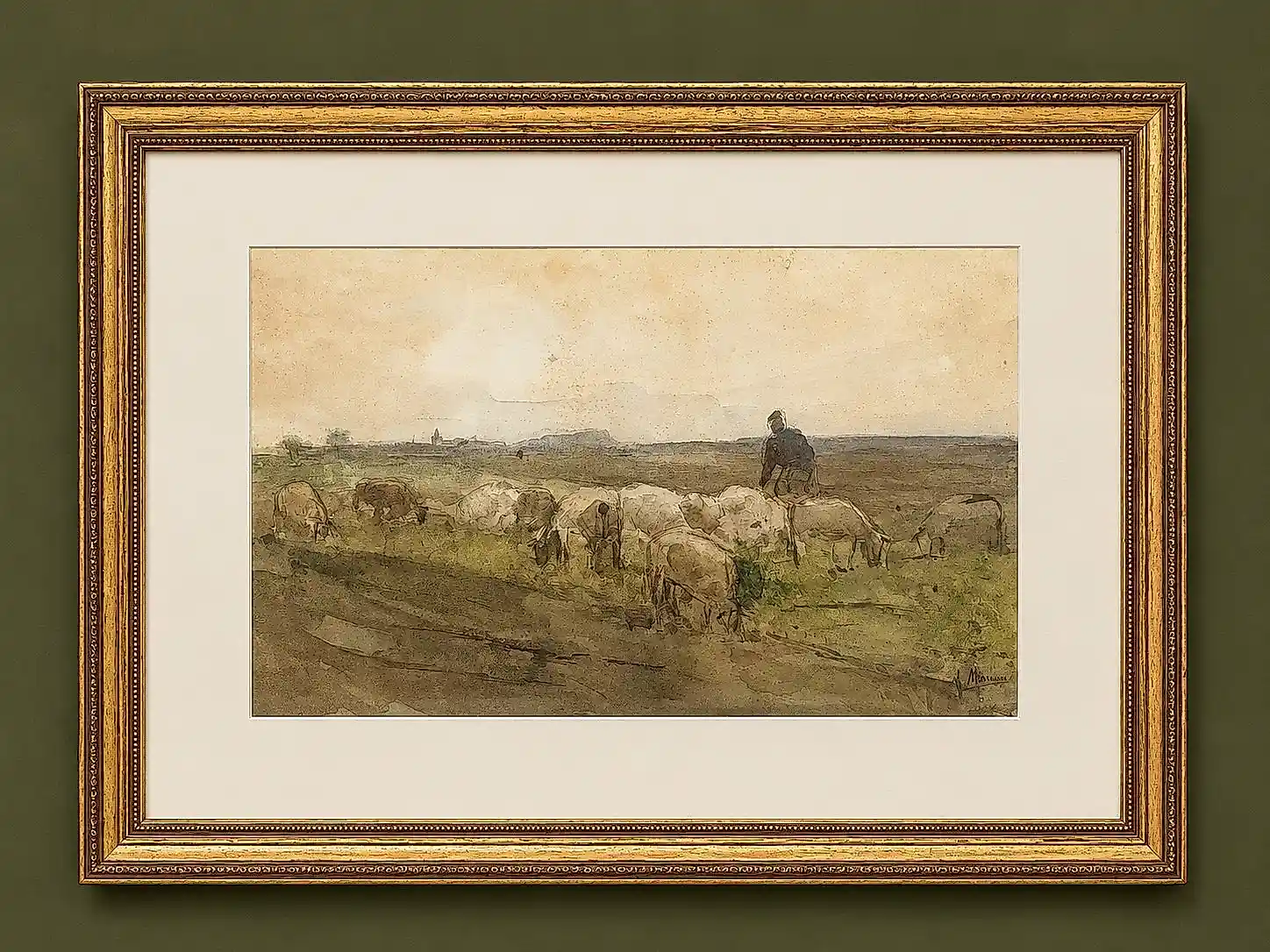
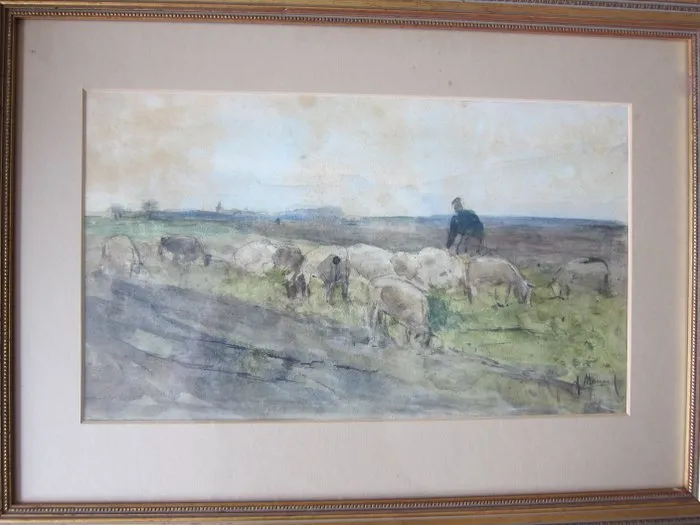
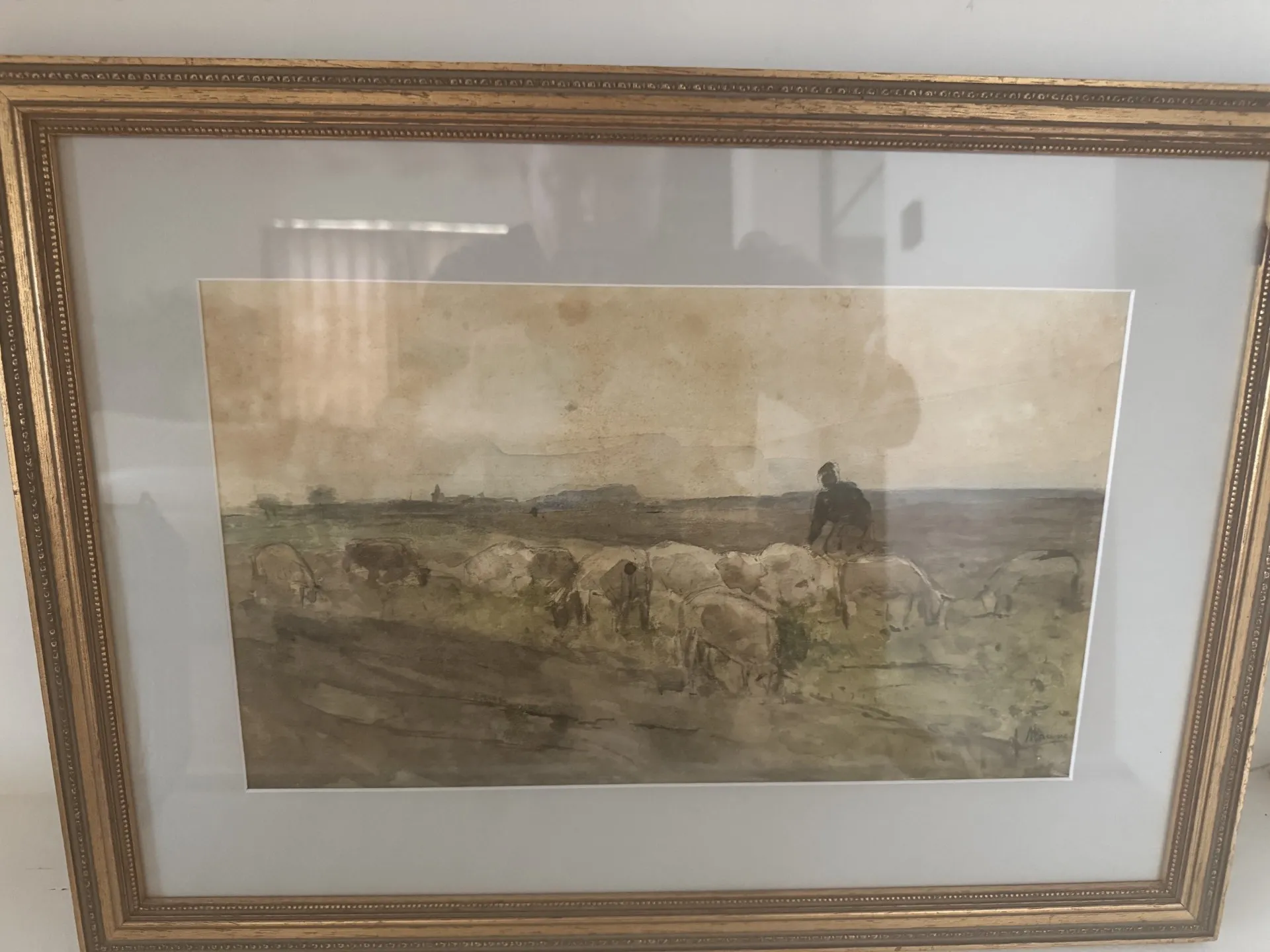
Anton Mauve (sr.) - Shepherd with sheep

Starting bid €650
Buyer's premium : 15%
| Pick up | Yes, possible |
| Location | Oisterwijk, The Netherlands |
Auction details
| Start time | 9-11-2026 at 10:10 |
| End time | 21-11-2026 at 21:06 |
Please note: if a bid is made in the last 5 minutes, the auction will be extended by 5 minutes.
K
kunst_online The Netherlands
2017 | |
54 sold | 3 followers |
- Description
- Anton Mauve (sr.) (1838-1888)
| Type of artwork | Drawing / Aquarelle |
| Period | 1800 to 1899 (19th century) |
| Technique | Aquarelle |
| Support | Paper |
| Style | Classical |
| Subject | Landscape |
| Framed | Framed |
| Dimensions | 21.5 x 37.5 cm (h x w) |
| Incl. frame | 36.5 x 51.5 cm (h x w) |
| Signed | Hand signed |
Translated with Google Translate. Original text show .
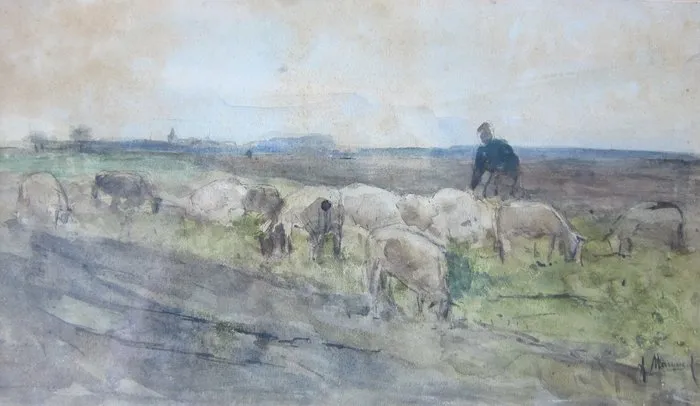
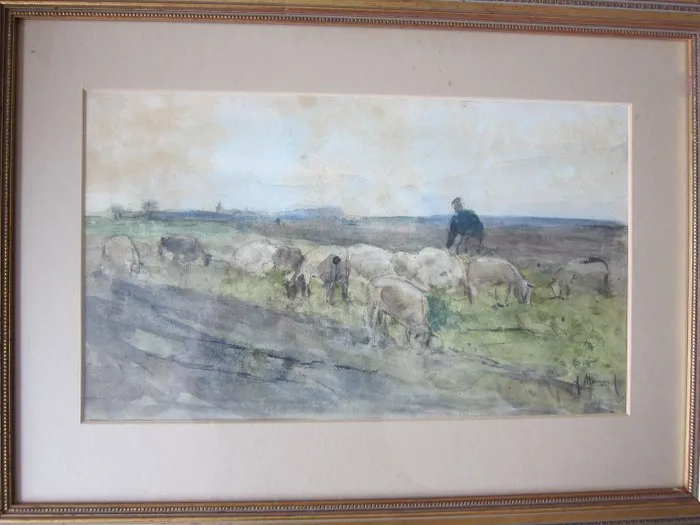
Anton Mauve (1838-1888) – Shepherd with sheep
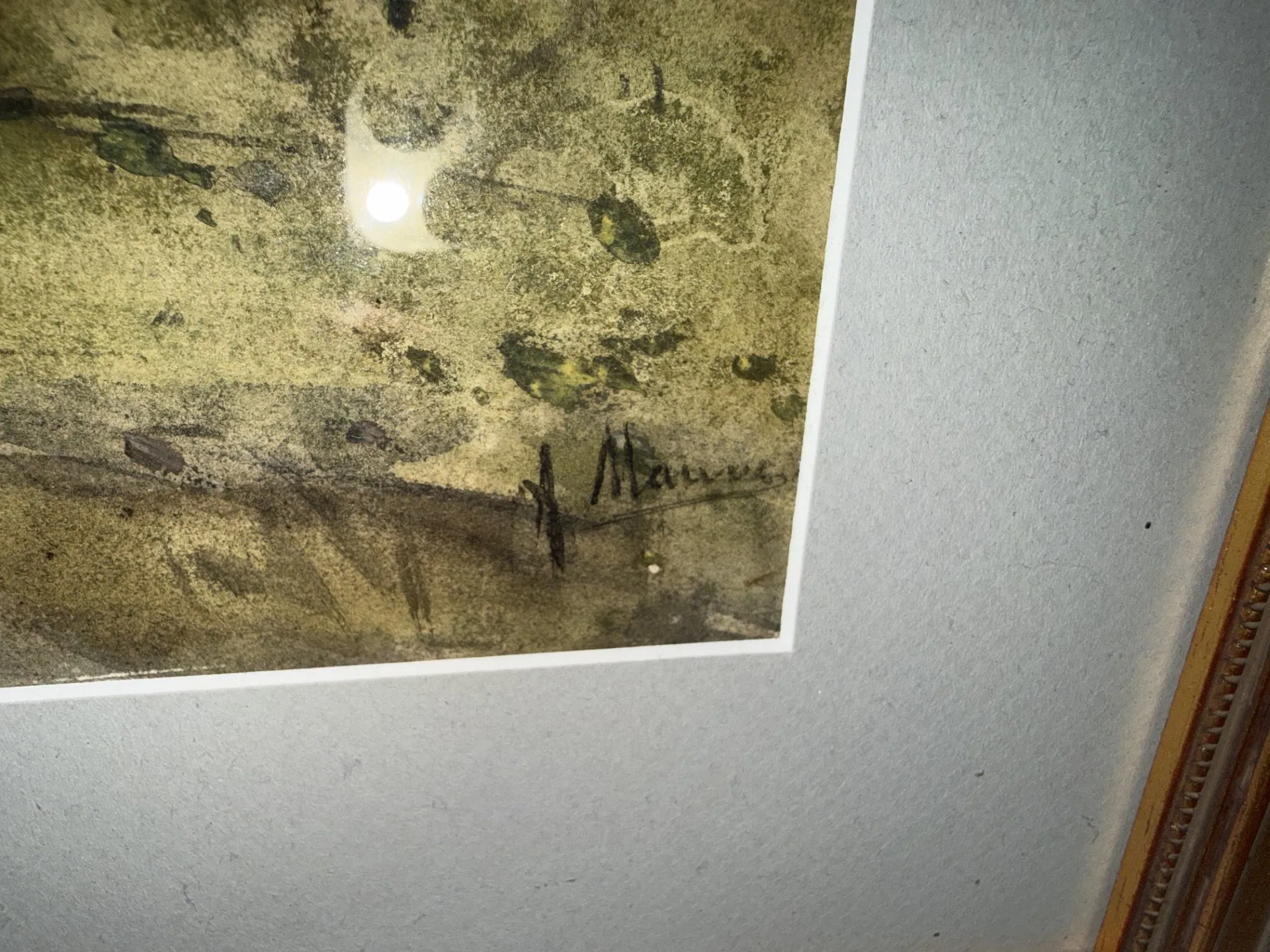
Watercolor. Signed lower right.
Frame dimensions: 51.5 x 36 cm
Work dimensions: 36 x 21.5 cm
Beautiful, typical watercolor by Anton Mauve from his Laren period. The watercolor is in reasonably good condition and has discoloration in the paper (see photos). The frame is offered free of charge and is not part of the work. Provenance: Glerum, The Hague, 1-10-1996 Anthonij (Anton) Mauve (Zaandam, 18 September 1838 – Arnhem, 5 February 1888) was a Dutch painter and printmaker. Life and work Mauve was born in Zaandam in 1838 as the son of the Mennonite minister Willem Carel Mauve (1803-1869) and Elisabeth Margaretha Hirschig (1805-1876), a cousin of Antonius Hirschig, the grandfather of Anton Hirschig, who shared the last days of Vincent van Gogh.[3] A year after his birth in Zaandam, the family moved to Haarlem, where his sister and future singer Susanna Pouwlina Mauve was born. He grew up there, and it was there that the desire to become a painter arose. He received permission from his father to pursue an art education, provided he obtained the certificate to teach drawing. The reason for this was that it offered social security. From 1854 to 1857, he painted as an apprentice in the studio of Pieter Frederik van Os. Subsequently, in 1858, he also apprenticed for several months with Wouterus Verschuur. In his further development, he collaborated with Paul Gabriël, Marinus Heijl, and JJ Doffegnies. During that period, he painted in the style of the Hague School. Mauve was a co-founder of the Hollandsche Teekenmaatschappij and a member of Kunst Zij Ons Doel from Haarlem. Anton Mauve married Ariëtte Sophia Jeannette (Jet) Carbentus (1856-1894), who was eighteen years younger and a cousin of Vincent van Gogh. In late 1881, at the age of 28, Vincent went to work for about three weeks at the Hague studio of his cousin by marriage. Through him, Vincent came into contact with the work of, among others, Jaap and Matthijs Maris, J.H. Weissenbruch, H.W. Mesdag, G.H. Breitner, and Jozef Israëls. Mauve gave Vincent painting lessons. Mauve's influence on Vincent was greater than is generally assumed. He adopted themes such as diggers, potato eaters, and timber merchants from Mauve. Vincent came into conflict with Mauve due to his relationship with Sien Hoornik. When Anton Mauve died suddenly in Arnhem in 1888, Vincent dedicated his *Souvenir de Mauve*, pink blossoming peach trees, to him in Arles. Mauve spent his most productive years in Laren, North Holland, where he was one of the founders of the Laren School. He painted many of his paintings in the Laren area. The Gooi region was also known by many tourists and art connoisseurs as 'The Land of Mauve'. Around 1900, Mauve's work was also highly popular internationally, particularly in the United States. During the American Gilded Age, Hague School paintings were actively collected by wealthy American collectors and industrialists. Through art dealers such as M. Knoedler & Co., works by Mauve ended up in important American collections and museums, including the Mallejan in the Carnegie Museum of Art. In 1887, Mauve won a gold medal at the Paris Salon with his painting *The Return of the Herd*. His son, Anton Rudolph Mauve Jr., also became a painter. Anton Mauve died of an aneurysm. From September 2009 to January 2010, Teylers Museum in Haarlem and the Singer Museum in Laren organized a joint exhibition of the work of Anton Mauve.
| Condition | |||||||||||
| Condition | Reasonable | ||||||||||
| Has some discoloration due to age of work | |||||||||||
| Shipment | |||||||||||
| Pick up | The work can be picked up on location. As a buyer you must bring your own packaging materials. The location is: Oisterwijk, The Netherlands | ||||||||||
| Shipment | Parcel post Please note: When shipping via parcel post, glass breakage is at the buyer's risk. | ||||||||||
| Price | > 10KG or bigger than 1.00 x 0.50 meter
| ||||||||||
| Guarantee | |||||||||||
| Guarantee | By putting the item up for auction, I agree with the Terms of Guarantee as they are applicable at Kunstveiling regarding the accuracy of the description of the item | ||||||||||
| Consumer law | This seller has indicated that they are a private seller. Therefore, consumer law does not apply. Read more | ||||||||||
The seller takes full responsibility for this item. Kunstveiling only provides the platform to facilitate this transaction, which has to be settled directly with the seller. More information .
Anton Mauve (sr.) (1838-1888)
 Dutch
K
kunst_online The Netherlands
2017 | |
54 sold | 3 followers |
Aquarelle 1800 to 1899 (19th century) Haagse School Pulchri Studio Veluwezoomschilders Kunst Zij Ons Doel
51.5 cm
36.5 cm
37.5 cm
21.5 cm